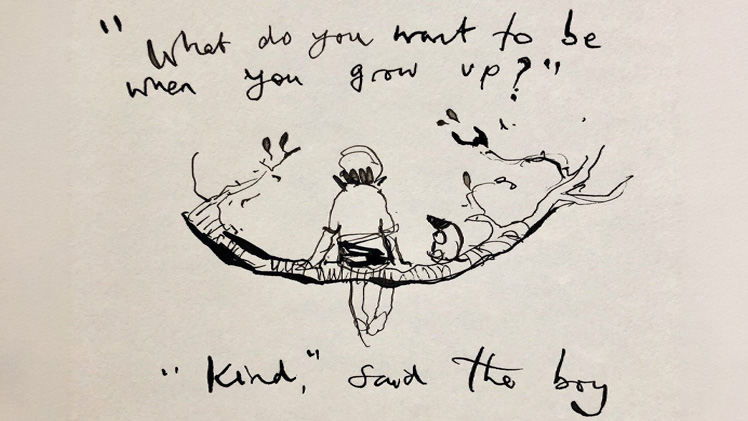
… But Words Can Break My Heart.
When Toni Morrison received the Nobel Prize for Literature in 1993, her acceptance speech included the following words: Oppressive language does more than represent violence; it is violence; does more than represent the limits of knowledge; it limits knowledge. Whether it is obscuring state language or the faux-language of mindless media; whether it is the proud but calcified language of the academy or the commodity driven language of science; whether it is the malign language of law-without-ethics, or language designed for the estrangement of minorities, hiding its racist plunder in its literary cheek – it must be rejected, altered and exposed. It is the language that drinks blood, laps vulnerabilities, tucks its fascist boots under crinolines of respectability and patriotism as it moves relentlessly toward the bottom line and the bottomed-out mind. Sexist language, racist language, theistic language – all are typical of the policing languages of mastery, and cannot, do not permit new knowledge or encourage the mutual exchange of ideas.
This got me thinking about the ‘sticks & stones’ response to playground taunts from the 1940s when bullying and name calling was just another part of the recess routine. Not quite as quoted above, the response actually ended with “but names will never hurt me.” Hmmnn. Really? True or False. I can remember being called a “half breed” in Vacation Bible School because my mother had not yet converted from her resplendent Russian Orthodoxy to what was then the very strict German Lutheranism that became my introduction to religion and its mysteries. In my memoir, Arms Filled With Bittersweet, the piece titled “Chicken Salad on Wonder” addresses some of those mysteries. (You are welcome to read it here, if you’d care to) Somewhere along the line I began to recognize and to consider the power of language that Toni Morrison expressed so eloquently some 35 years later.
If you’ve been paying any attention at all to the goings on in our country these days, you probably didn’t need a cage fight on the White House lawn, the latest tally of deaths in ICE detention or the ongoing intimidation of protesters, to confirm oppressive and violent as the new ‘First Language” of today’s America. We might go so far as to add cruelty. BUT (and this, to me, is where the most powerful value truly lives) … let us not overlook the antonym vocabularies of “oppressive”, such as liberating, supportive, and empowering. Or those of “violent”, like peaceful, gentle, and calm. And the opposite of “cruel” – kindness, compassion, mercy. Today I invite you to visit some of the language I have found these past weeks to bring me gratitude, joy, and hope.
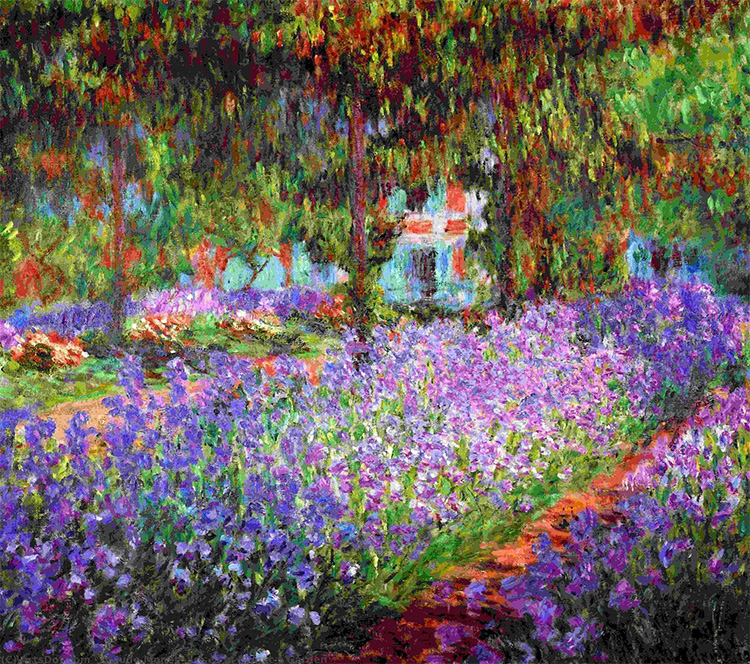
One of our great multitude of choices these days is the way we look at the world and how we choose to see what’s there. June 11th’s Daily Good featured a very brief essay by Parker Palmer called “Looking at Life With Soft Eyes.” In it he says … When I look with soft eyes on this hard-frozen winter in American history, what I see deep-down is a people preparing to rise again. Millions of us can still feel the new life we found by taking to the streets last summer, fall and early spring. We’ve been connecting as the trees do, underground, sending texts, emails, money and moral support, preparing to rise again to bring our misleaders down. The norms of love, truth and justice can be flouted only so long before a majority realize that we’re on the road to hell, led by people who already own property there. There is also this poem.
Monet Refuses the Operation
By Lisel MuellerDoctor, you say there are no haloes
around the streetlights in Paris
and what I see is an aberration
caused by old age, an affliction.
I tell you it has taken me all my life
to arrive at the vision of gas lamps as angels,
to soften and blur and finally banish
the edges you regret I don’t see,
to learn that the line I called the horizon
does not exist and sky and water,
so long apart, are the same state of being.
Fifty-four years before I could see
Rouen cathedral is built
of parallel shafts of sun,
and now you want to restore
my youthful errors: fixed
notions of top and bottom,
the illusion of three-dimensional space,
wisteria separate
from the bridge it covers.
What can I say to convince you
the Houses of Parliament dissolve
night after night to become
the fluid dream of the Thames?
I will not return to a universe
of objects that don’t know each other,
as if islands were not the lost children
of one great continent. The world
is flux, and light becomes what it touches,
becomes water, lilies on water,
above and below water,
becomes lilac and mauve and yellow
and white and cerulean lamps,
small fists passing sunlight
so quickly to one another
that it would take long, streaming hair
inside my brush to catch it.
To paint the speed of light!
Our weighted shapes, these verticals,
burn to mix with air
and change our bones, skin, clothes
to gases. Doctor,
if only you could see
how heaven pulls earth into its arms
and how infinitely the heart expands
to claim this world, blue vapor without end.
Palmer’s essay ends with this: Is all of this “mere poetry?” Or might words like these be our marching orders for the “eye exam” Americans will have on November 3, when we will get yet another chance to look at the chart and say, “I see a path toward a more perfect union”? The answer to that question depends on what we do between now and then—and that in turn depends on more of us seeing through soft eyes that we really are in this together.
Here’s a little something you might want to give some thought … For the first time in the internet’s history, bots now outnumber humans. Cloudflare reports that automated bots and AI agents have overtaken human web traffic — 57.4% bots to 42.6% humans worldwide, and a stunning 71.5% bots inside the United States. CEO Matthew Prince admitted the crossover “happened faster than I predicted,” years ahead of schedule. Odds are high that that person you’re arguing with on X or Facebook is actually a bot run by a rightwing-programmed AI program. The web that millions of us built is now mostly software talking to software, scraping the work of human creators for free to feed the next trillion-dollar AI valuation. We’ve seen this movie before: a thing the public makes gets quietly enclosed and monetized by the handful of oligarchs who own the pipes. The only question is whether anyone left is aware of the trend to notice.
I love being able to pass on stories that thoughtful friends and acquaintances send me, like this post titled “Girls With Gardens”. I especially love it when I hear back that a reader was inspired by what they read or heard.
Seven acres of free food sits in the middle of a former food desert. No fence. No fee. Just pick what you need.
Atlanta just created the largest public food forest in America. Seven acres of fruit trees, nut trees, vegetable beds, and herb patches planted on public land in a neighborhood where grocery stores are scarce and fresh produce is scarcer. You do not need a membership card. You do not need to qualify for anything. You walk in and you harvest. Peaches. Figs. Pecans. Collards. Mint. Rosemary. The design is based on food forest principles — layered plantings that mimic natural forest structure while producing human food at every level.
This is not a community garden with individual plots and waiting lists. It is a commons. The city owns the land. A nonprofit manages the plantings. The neighbors eat the harvest. In a former food desert, that changes what is possible. Kids who have only seen apples in plastic bags can watch them ripen on a tree. Families who budget around canned vegetables can walk home with fresh greens. The forest is young now. The trees are small. But in five years, seven acres of mature food forest will produce more fresh food than any convenience store in the neighborhood. And nobody will ask you to pay for it.
And this from Robert Reich. I was at a team-building retreat of sorts last week and one of the exercises involved writing on sticky notes one-liners that speak to us of hope. One of mine was “smiling at strangers.” Sometimes, like with Robert Reich, it doesn’t even take a smile. Here’s a very quick and reassuring read about a brief conversation on the way to breakfast. For me, the practice of smiling at strangers is the perfect equal-opportunity connector. Just one Human to another, no matter who we are, where we’re from, the color of our skin or who we have loved or hurt or voted for. Just the simplest of random kindnesses.
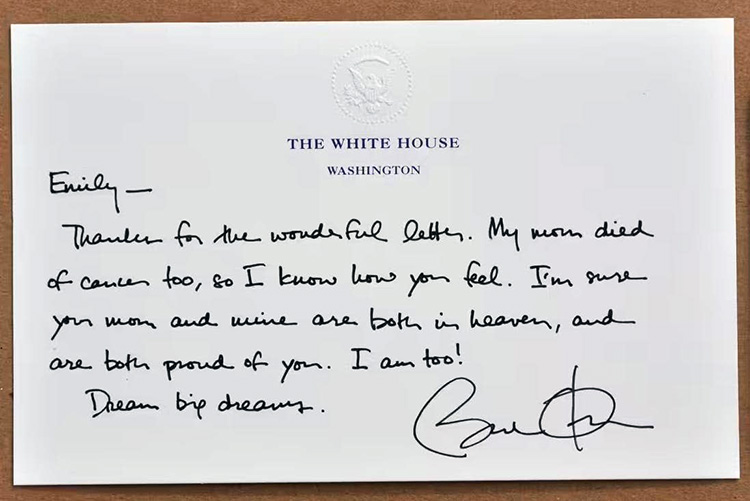
2026 has been something of a momentous year for me. I’m much more of a homebody these days, hardly traveling. I’d love to go to Chicago and visit the new Presidential Center, but likely will not. The tour and interviews with the Obamas that happened last week were amazing and I’m so glad to have seen them. It was heartwarming to see kindness and generosity of spirit in high places and know that it can happen again and that we can still dream big dreams. I was particularly struck by some of the letters that the President took time to read and respond to each night, maybe none so much as the card he wrote to little Emily, whose mom had recently died of cancer. In case you didn’t happen to see it …
And then, of course, there can be no overlooking commencement speeches. I wasn’t able to attend my great-granddaughter’s high school graduation, but heard from her grandma that the ceremony, in true Portland fashion, was a joyously colorful celebration of diversity, equity, and inclusion.
In Texas, thank goodness, there is James Talarico, hopefully the Lone Star State’s next U.S. Senator, who gave this year’s commencement speech at Paul Quinn College. It’s titled “Unshakeable Things: Gen Z and the New Great Awakening” and is well worth the 20 minutes it will take to watch it here.
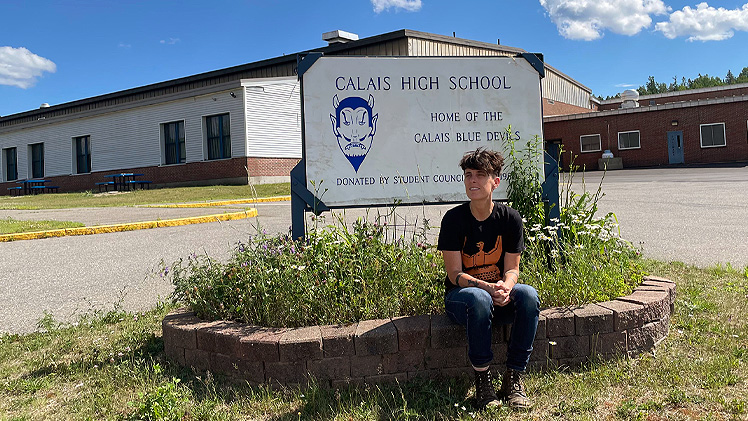
For some of us, pivoting from politics to poetry is as natural as taking a breath. Go back with me for a minute to Parker Palmer, who said, Is all of this “mere poetry?” Or might words like these be our marching orders for the “eye exam” Americans will have on November 3, when we will get yet another chance to look at the chart and say, “I see a path toward a more perfect union”? Or as the late Mary Oliver put it … “For poems are not words, after all, but fires for the cold, ropes let down to the lost, something as necessary as bread in the pockets of the hungry”. It’s almost a year now since the remarkable poet Andrea Gibson left us and I’m so grateful to continue receiving their wife, Megan Falley’s, posts. Most recently, Megan shared this previously unpublished commencement speech Andrea made to the senior class of their Calais, Maine high school, titled (not surprisingly) “Do Not Rule Out What Scares You”.
At last it is officially summertime and according to the classic Gershwin tune from the thirties … the livin’ is easy. Hmmmn. We’ll have to see about that. But … in the interest of easy and refreshing hot weather meals, I hereby gift you my recipe for Cold Avocado & Cucumber Soup with Buttermilk. It’s part of the Summer section of my book, All In The Soup Together … Four Seasons of Recipes & Reflections (for people who like soup and poetry on the same menu).
And let’s not end our time together without a song. A Letter to Our Allies … Please Don’t Give Up On Us is a powerful protest song inspired by an opinion piece from Robert Reich, who BTW just joined our “Still Here ‘80s Club”. Happy Birthday, Bob!!
So … until next time, let’s remember to be kind, to smile at strangers, and to consider the words of Alice Walker, who said, Love is not concerned with whom you pray or where you slept the night you ran away from home. Love is concerned that the beating of your heart should kill no one. May it be so. See you again soon.
Love,
Sulima
One very last thought … actually two. (1) my truly heartfelt recommendation for a beautiful new novel called Theo of Golden by Allen Levi. It’s on the NYT Best Seller list so you may already know about it, maybe even already read it. I’d love to get together and talk about it sometime. Would you? (2) If you’d like to have a copy of my memoir, Arms Filled With Bittersweet or All In The Soup Together, reach out to Lingua Ink for the “Friends & Family” price + current postage. They are also available on Amazon, but be forewarned that AITST is not spiral-bound there (definitely my preference for a book with recipes).
Buying me an occasional coffee helps me keep these stories coming … and gives me one less reason to cross my fingers when my Social Security payment is due!