
The first act of citizenship is to incline our hearts again and again toward love, truth and justice, saying no to all that stands against them. Every day in every way, the choice is in our hands.
—Parker Palmer
My calendar tells me we are reaching the end of August, but wasn’t it just a few days ago we celebrated the Summer Solstice? Time to slow down and take a breath, yes? When I first began thinking about how this post might come together, I was inspired by something I read about “the quiet ones who refuse to look away,” and I recognized myself as being one of them (although some might question the ‘quiet’ part). I began to accumulate bits of wisdom about not looking away that kept coming at me from here and there. So, if you’re willing to take a few minutes from your busy and otherwise occupied day to wander here and there with me, Welcome!
Let’s begin with Parker Palmer’s Living the Questions blog from the 4th of July, where this bold opening statement caught my eye: “At 250, the U.S.A. is stuck in adolescence. Let’s grow up, own who we are, and get on with the challenge of becoming a democracy…” Indeed! Then Palmer goes on to say: “For two and a half centuries, We the People have been unable to embrace the fact that the U.S. has both succeeded and failed when it comes to the claims of love, truth and justice – and that our failures have been most costly to those who fall short of white, patriarchal Christian supremist norms. At 250, we are a textbook case of arrested development.” Oh My Goodness!! My next thought? I wonder where we might go with this.
Let me take you back to my June 24th post where I had some things to say about sticks & stones breaking my bones, but words being able to break my heart. I reported being at a team-building retreat where one of the exercises involved writing on sticky notes, one-liners that spoke to us of hope. One of mine was smiling at strangers. As it turns out, researchers at Harvard have given a name to something many of us already know and have been practicing for some time; that a smile in a hallway, a word of thanks at a checkout counter, or a moment of genuine recognition can quietly shift the feel of a day. Drawing on the tools of epidemiology (the study of how things like disease spread through populations) they propose that kindnesses too can ripple outward from person to person, and can, over time, shape the emotional atmosphere of classrooms, workplaces, and neighborhoods. They call these gestures “microkindnesses” – defined as small acts “motivated at least in part by genuine warm feelings toward others”. Their findings, in part as follow, carry a quiet moral weight (isn’t that a lovely phrase?). If small slights (microagressions) can accumulate into real harm, then it would seem that small gestures of goodwill might accumulate into something like repair. A kinder society, the research suggests, is not only built through grand commitments, but also assembled, moment by ordinary moment, in doorways and check out lines. Suddenly, out of nowhere (I honestly can’t tell you where I saw it) came this quote from Jane Barlow Christensen: “… the future isn’t shaped by a handful of grand gestures. It’s shaped by millions of individuals who decide, day by day, not to accept what they know can be better. CAN be better. And when enough people make that decision, the collective inevitably follows.” Imagine that. Maybe not just “New Age WhooWhoo” anymore.
Harvard’s Human Flourishing Program is careful not to overstate the claim, however. In an article you can read here, we are reminded that “microkindness is not a cure for social division, loneliness, or injustice. Nor is every kind gesture necessarily received as ‘kind’. Context, culture, relationship, and power all shape how such actions are interpreted.” Still, the idea is important for the study. The Human Flourishing Program’s framework understands flourishing as multidimensional, including happiness and life satisfaction, physical and mental health, meaning and purpose, character and virtue, close social relationships, and financial and material stability. Microkindness, while especially relevant to character, virtue, and close social relationships, may also affect the emotional tone and meaning of everyday life … Enough said. How about this for a reminder?
“… the future isn’t shaped by a handful of grand gestures. It’s shaped by millions of individuals who decide, day by day, not to accept what they know can be better. CAN be better. And when enough people make that decision, the collective inevitably follows.” — Jane Barlow Christensen
Small Kindnesses
Danusha Laméris
I’ve been thinking about the way, when you walk
down a crowded aisle, people pull in their legs
to let you by. Or how strangers still say “bless you”
when someone sneezes, a leftover
from the Bubonic plague. “Don’t die,” we are saying.
And sometimes, when you spill lemons
from your grocery bag, someone else will help you
pick them up. Mostly, we don’t want to harm each other.
We want to be handed our cup of coffee hot,
and to say thank you to the person handing it. To smile
at them and for them to smile back. For the waitress
to call us honey when she sets down the bowl of clam chowder,
and for the driver in the red pick-up truck to let us pass.
We have so little of each other, now. So far
from tribe and fire. Only these brief moments of exchange.
What if they are the true dwelling of the holy, these
fleeting temples we make together when we say, “Here,
have my seat,” “Go ahead—you first,” “I like your hat.”
And Thank You for this, Robert Arnold, from your Substack post of August 1st.
Most people think democracy happens on Election Day.
It doesn’t.
Election Day is simply the day democracy reveals whether we’ve done the work leading up to it.
Democracy is built on ordinary Tuesdays.
It is built in classrooms where students first learn how their government works.
It is built in church fellowship halls where volunteers teach neighbors how to register to vote.
It is built in conversations around dinner tables, at barbershops, on front porches,
and at city council meetings where citizens decide that the future of their community
is too important to leave entirely to someone else.
Democracy is not an event.
It is a habit.
This sweet drawing illustrates Awakin.org’s offering of August 10th From the Mind to the Heart, reminding us that Our mind is not our enemy. It is a sacred gift. It helps us think, question, imagine, and understand the world. 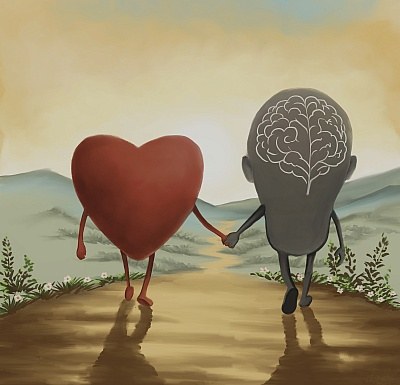 But the mind is not the place where life reaches its deepest fulfillment. It is the path that gently leads us to the heart … The mind can gather endless knowledge, but only the heart can transform knowledge into wisdom. The mind can plan a life of success, but only the heart can awaken a life of meaning. When the mind walks alone, it often seeks certainty, control, and achievement. When it walks with the heart, these same abilities become instruments of compassion, courage, and service … Perhaps this is what it means to be truly rich: not to have more, but to need less: not to stand above others, but to belong with them; not to collect more for ourselves, but to become a channel through which love, compassion, and generosity quietly flow into the world.
As I’ve taken time to review some of the posts in my Light Waves archives, I realize this is yet another version of the same message I’ve been sending for years, with the heart always at the heart of it. For example, January 26, 2023 ‘There Is Always a Light,’ where I say “Reaching consensus can be messy, disruptive, and time consuming. With so much else on our plates, do we really have time for that kind of deep listening?” My reply to that question? Check out Crossing Party Lines and Robert Reich’s soon-to-be-released documentary film, The Work in Progress.
Rachel Naomi Remen, one of my favorite “wisdom teachers,” and a pioneer in the fields of healing and integrative medicine, (who left her body on August 8th at the age of 88) encouraged her medical students to practice the art of “generous listening”, where In a space of safety, people can discover what’s true for them for the first time. “This kind of listening”, she said, “heals people.”
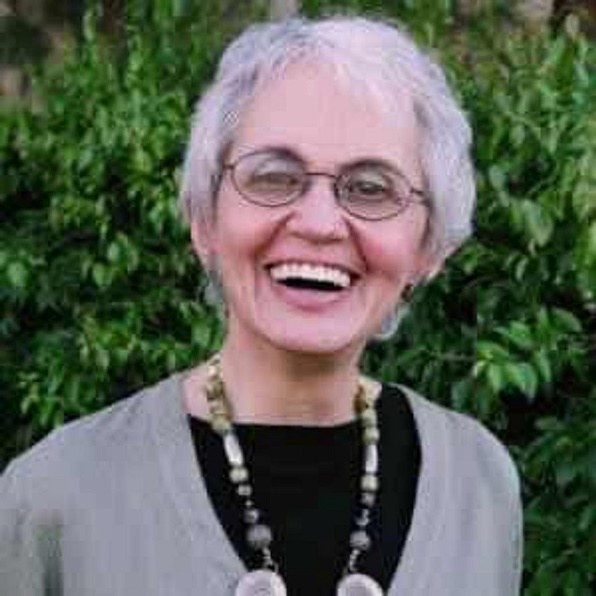 “Perhaps the most important thing we bring to another person is the silence in us, not the sort of silence that is filled with unspoken criticism or hard withdrawal. The sort of silence that is a place of refuge, of rest, of acceptance of someone as they are.” — Rachel Naomi Remen
And then, of course, there is our ever-beloved Mary Oliver, held close and dear in the just-released documentary film, Mary Oliver: Saved by the Beauty of the World. Oliver’s poetry continues to inspire both liberals and conservatives, atheists and believers, naturalists and urbanites, Boomers and GenZs. If poetry had a pop icon or a patron saint, it would likely be Mary Oliver. The film is an amazing and enduring love story that holds Oliver’s writing at its heart, rooted in her own language and indeed, in the beauty of the world. With so many of her poems to choose from, here is a more obscure favorite from my personal lessons file.
I Worried
By Mary Oliver
I worried a lot. Will the garden grow, will the rivers
flow in the right direction, will the earth turn
as it was taught, and if not how shall
I correct it?
Was I right, was I wrong, will I be forgiven,
can I do better?
Will I ever be able to sing, even the sparrows
can do it and I am, well,
hopeless.
Is my eyesight fading or am I just imagining it,
am I going to get rheumatism,
lockjaw, dementia?
Finally I saw that worrying had come to nothing.
And gave it up. And took my old body
and went out into the morning,
and sang.
As we say Goodbye to Summer, let’s take a moment to take our bodies (old or not) out into the morning and remind ourselves that holding on to hope is one of the most defiant things we can do right now. I’m totally with Scot Nakagawa, who opens his Anti-Authoritarian Playbook post with these words: “If you feel worn down lately – like the news arrives faster than you can process it, like every week brings a new edict, a new outrage, a new reason to despair – I want you to know the feeling is not an accident. It’s the point. And I want to make a case that sounds soft but is actually the hardest, most strategic I know: hope is not a mood we can afford to lose. It’s a weapon. In dark times it may be the most important one we have.” And while we’re at it, let’s not forget that just 106 years ago this month, the 19th amendment to our constitution gave American women the right to vote. We cannot afford to look away, lest that right, like Roe v Wade, is removed. I know how exhausting it can be to keep paying attention, to keep from looking away. Clearly, it is impossible to keep up with everything, and worrying will surely get us nowhere. So I wish for us all the strength to stay open and willing to figure out where we can best place our attention, and to do what is ours to do.
Until next time … Sing, Dance, Smile at Strangers, and let us Love our way through this together. And … if you haven’t read it yet, and your heart could use a little warming, do pick up a copy of Theo of Golden by Allen Levi. If you have read the book, I’d love to hear your thoughts, or maybe we could put together a Zoom call to talk about it. Let me know.
Sending Love,
Sulima
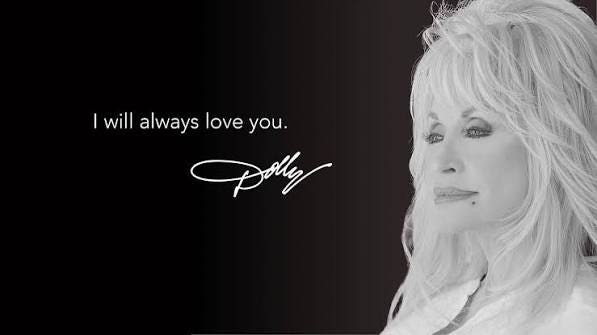 P.S. Dear Dolly Parton, we will always love you.
New here? Subscribe to Light Waves and I’ll land in your inbox next time.
Buying me an occasional coffee helps me keep these stories coming … and gives me one less reason to cross my fingers when my Social Security payment is due!


